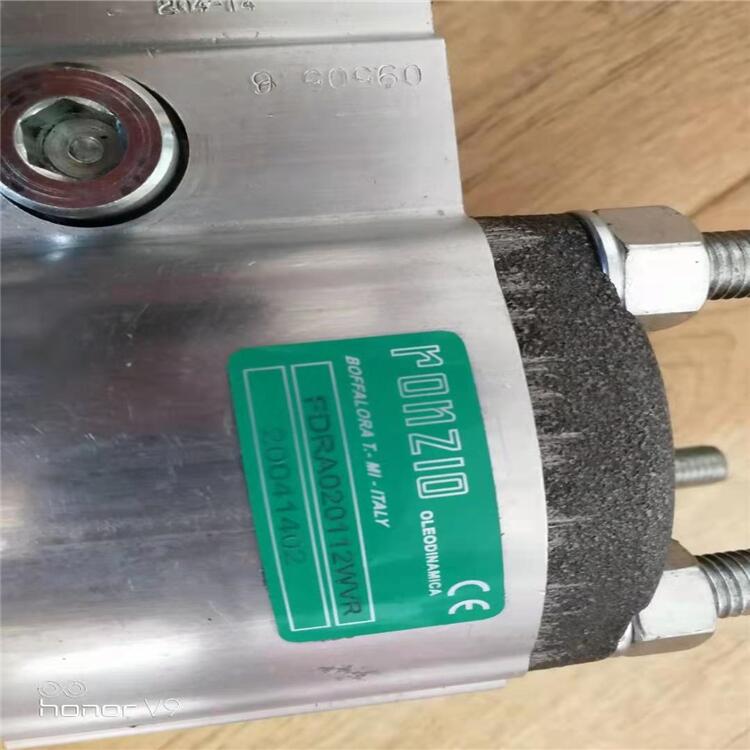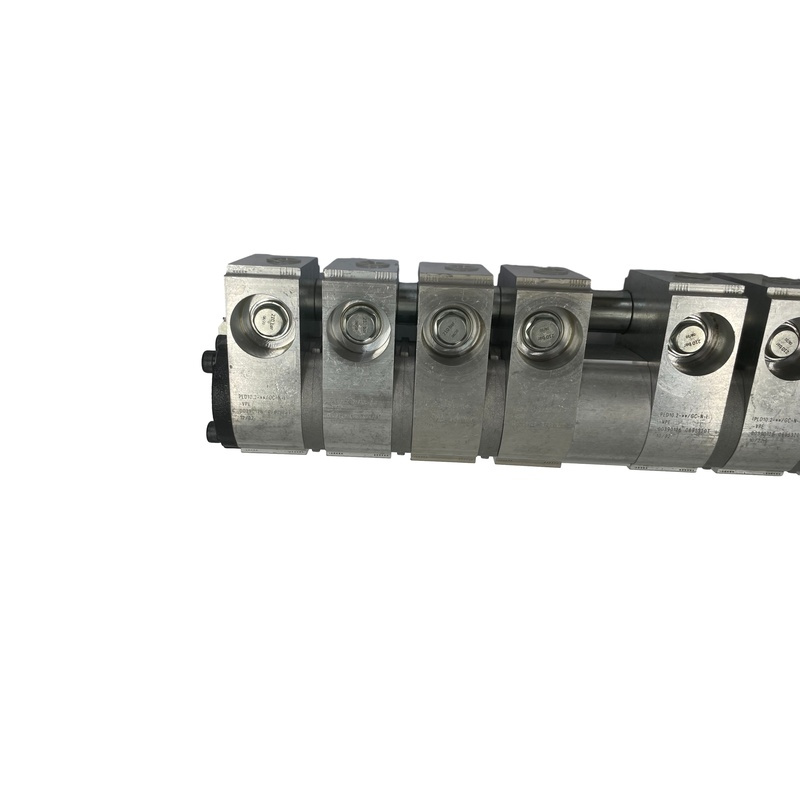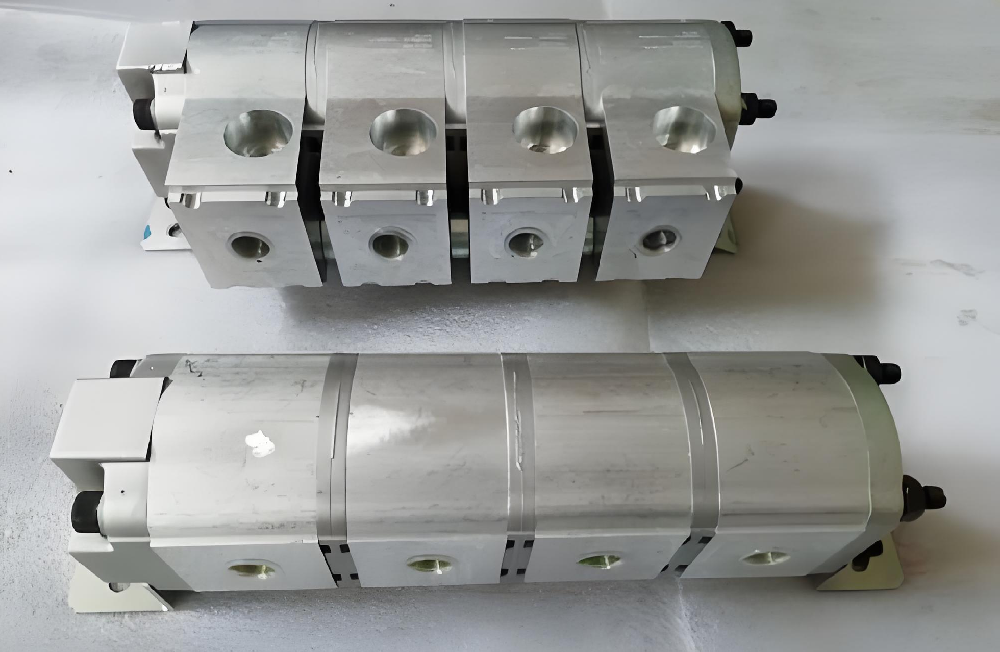
The Casappa PLD20/4/CS-GE/16-GD is correctly classified as a Gear Flow Divider.This device,also widely known as a hydraulic gear divider or rotary flow divider,is a critical component for achieving precise and reliable motion synchronization in hydraulic systems.Unlike valves that regulate flow through external control,this unit uses a purely mechanical,gear-driven principle to distribute a single incoming fluid stream into multiple,highly consistent output flows.The PLD20/4/CS-GE/16-GD model from Casappa exemplifies this technology,offering a durable and efficient solution for synchronizing cylinders or motors in demanding industrial and mobile applications.
Product Overview and Core Function
The Casappa PLD20/4/CS-GE/16-GD is part of the PLD20 series of modular gear-type flow dividers.Its primary function is to ensure that two or more hydraulic actuators—such as cylinders lifting different points of a platform or motors driving parallel conveyors—move in precise synchrony,regardless of variations in the load each actuator faces.
This is achieved through an ingenious mechanical design.The unit contains multiple hydraulic gear motor sections(four,in the case of the"4"in this model number)that are mechanically locked together on a common shaft.When pressurized oil enters the common inlet,it drives the first gear set.Because all gear sets are physically connected,they are forced to rotate at exactly the same speed.Each section then acts as a pump,discharging an equal volume of oil per revolution.This mechanical coupling ensures that each outlet port delivers an almost identical flow rate,forcing synchronized movement even if one cylinder encounters more resistance than another.The device can also work in reverse as a flow combiner.
Detailed Technical Specifications and Performance Data
The PLD20/4/CS-GE/16-GD is engineered for high-performance duty.It operates at a maximum continuous pressure of 250 bar,with a peak pressure capability of 280 bar,indicating its suitability for robust industrial systems.
A key specification is the displacement of each individual motor section,which is 16 cubic centimeters per revolution(cc/rev)for this model.This displacement directly determines the flow delivered by each outlet.The operational speed range for the unit is between 1175 and 3460 revolutions per minute(rpm).Within this range,each outlet delivers a flow between 17 and 50 liters per minute,making it suitable for a wide array of medium-flow applications.
The synchronization accuracy is a critical performance metric.This model offers a standard synchronization error range of 1.5%to 2.5%,translating to a precision of 97.5%to 98.5%.This high level of accuracy is a hallmark of gear-type dividers and is sufficient for most material handling,levelling,and multi-actuator drive applications.The port connections are designed for standard hydraulic fittings,with a G3/4"inlet port and G1/2"outlet ports,facilitating straightforward integration into existing piping.
Design Characteristics and Operational Principles
The exceptional reliability and accuracy of the Casappa PLD20 series stem from its fundamental design philosophy and high-quality construction.
Modular&Scalable Architecture:The"4"in the model number signifies a four-section unit.Casappa's modular design allows these sections to be assembled in various configurations.This means the same core product platform can be used to create two-,three-,or four-way dividers,offering tremendous flexibility for system designers to match the exact number of actuators needing synchronization.
Pure Mechanical Synchronization:The core principle relies on the rigid mechanical connection(common shaft)between all internal gear sets.This is fundamentally different from electronically or hydraulically controlled valve systems.There are no sensors,feedback loops,or complex controls that can fail.Synchronization is inherent to the device's operation,providing fail-safe performance that is immune to electrical interference or control system faults.
Handling Load Imbalance and Pressure Compensation:In a real-world application,it is common for one actuator to be under a heavier load than another.In such a scenario,the outlet leading to the heavily loaded actuator will see a much higher pressure.Internally,the gear section supplying this high-pressure outlet requires more torque to turn.This torque is transferred through the common shaft from the other gear sections.This interaction automatically balances the effort,allowing the unit to maintain flow division despite significant pressure differences between outlets,a capability described in foundational patents for this technology.
Primary Application Scenarios and Industry Solutions
The PLD20/4/CS-GE/16-GD finds its purpose in any hydraulic system where the unsynchronized movement of multiple actuators would lead to operational failure,safety hazards,or product defects.
Parallel Actuator Synchronization:The most common use is in synchronizing two or more linear cylinders.This is essential in applications like lifting platforms,scissor lifts,die-casting machines,or large industrial presses where multiple pistons must extend and retract in unison to prevent binding,tilting,or uneven force distribution.
Multi-Motor Speed Control:It can be used to ensure that several hydraulic motors run at precisely the same speed.This is crucial in mobile machinery like combine harvesters with multiple reel drives,or in industrial conveyor systems where several belts must move at identical speeds to transport material smoothly.
Proportional Flow Division(Custom Configurations):While the standard model provides equal flow division,the modular nature of the system allows for custom assemblies.By combining gear sections with different displacements(e.g.,a 16 cc/rev section with a 25 cc/rev section),the divider can be configured to deliver fixed,proportional flow rates(e.g.,60/40 split)to different parts of a system,enabling controlled,asymmetrical movements.
Comparative Advantages and Selection Guidelines
Choosing a gear flow divider like the Casappa PLD20 involves understanding its distinct place among synchronization solutions.
Versus Electronic or Servo-Valve Systems:Electronic systems offer high flexibility and can adjust ratios dynamically but are complex,expensive,and vulnerable to electronic failure.The Casappa PLD20 is a simpler,more robust,and often more cost-effective solution for applications requiring a fixed,reliable synchronization ratio.Its performance is not degraded by dirty hydraulic oil to the same extent as sensitive servo valves.
Versus Spool-Type Flow Dividers:Simple spool-type or orifice-based dividers are lower in cost but highly sensitive to changes in load and fluid viscosity,leading to poor accuracy.The gear divider maintains its accuracy across a wide range of pressures and temperatures due to its positive displacement principle,making it the superior choice for precision applications.
Key Selection Factors:When specifying a unit,engineers must consider the required number of outlets,the flow rate range per outlet(dictated by section displacement and system speed),the maximum system pressure,and the required synchronization accuracy.The Casappa PLD20 series,with its clear model numbering(PLD20/Number of Sections/.../Displacement-GD...),allows for straightforward selection based on these parameters.
Frequently Asked Questions(FAQs)
What is the main cause of synchronization error in a gear flow divider,and can it be improved?
The primary source of error is internal leakage(slippage)within each gear motor section,which is inherent to any positive displacement hydraulic component.While the mechanically locked shafts ensure each section attempts to move the same volume,slight variations in internal clearances can cause minute flow differences.The 1.5-2.5%error rating of the PLD20 represents this industry-standard performance.Accuracy can be maximized by ensuring the hydraulic fluid is clean and at its optimal operating temperature and by selecting a unit with a displacement rating well-matched to the required flow,ensuring it operates in the efficient mid-range of its speed capabilities.
Can a gear flow divider like the PLD20/4 be used with cylinders of different sizes?
Yes,but not with a standard equal-displacement unit.If cylinders have different bore sizes,they require different volumes of oil to move the same distance.To synchronize them,you would need a custom-configured flow divider where the displacement of each outlet section is proportional to the volume requirement of its corresponding cylinder.For example,a cylinder with twice the area would need a divider section with twice the displacement.Casappa's modular system supports building such custom proportional dividers.
How does the unit manage extreme pressure spikes or potential over-pressure at one outlet?
The standard PLD20/4/CS-GE/16-GD model,as indicated by its suffix,does not include integrated relief valves.System designers must install external pressure relief valves in each branch circuit to protect both the actuators and the flow divider itself from damage caused by pressure spikes or unexpected mechanical blocks.Some variant models in the series may include built-in relief valves for specific outlet sections,as noted in other model codes.
What maintenance is required for a long service life?
Gear flow dividers are known for their low maintenance.The key requirement is the same as for any precision hydraulic component:maintaining fluid cleanliness.Contaminated oil will accelerate wear on the internal gears and bearings,increasing internal leakage and degrading synchronization accuracy over time.Regular monitoring of system synchronization performance can serve as an early indicator of internal wear.
No.26, District 4, Maquanying Liyuan Community, Xiangjiang North Road, Cuigezhuang, Chaoyang District, Beijing.
+86 18221112592
https://www.hydraulic-supply-company.com