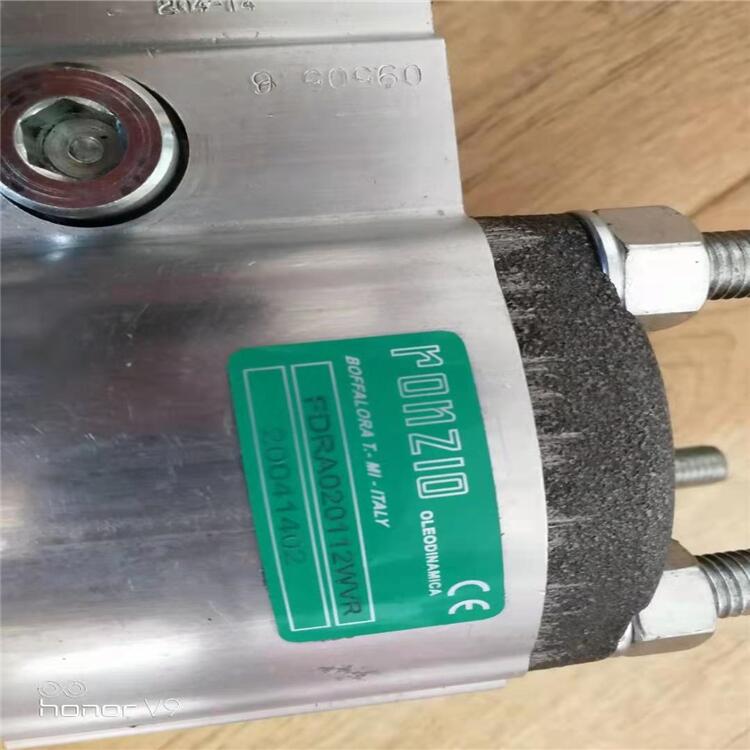
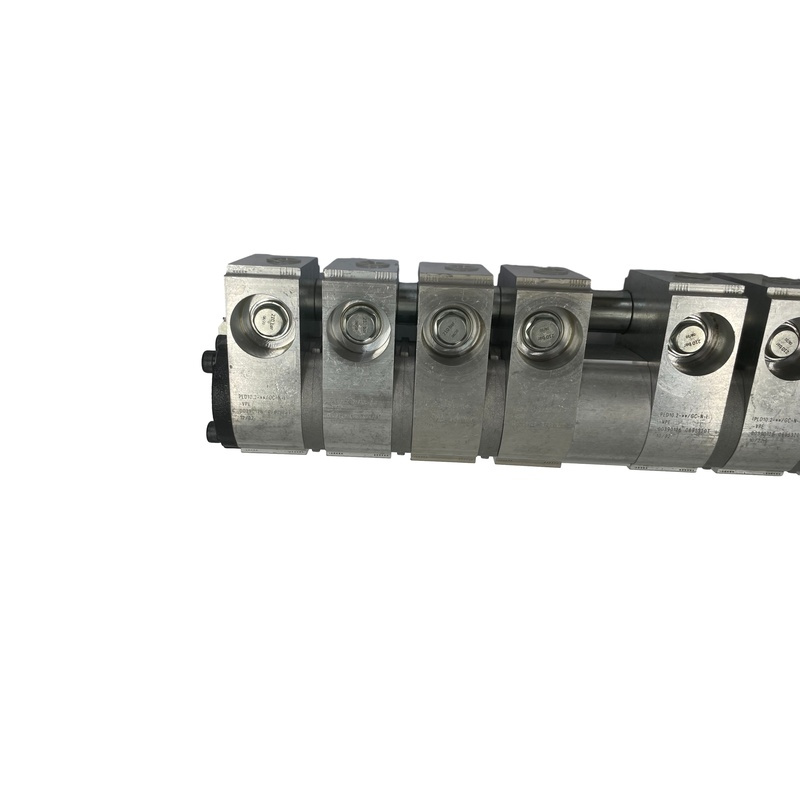
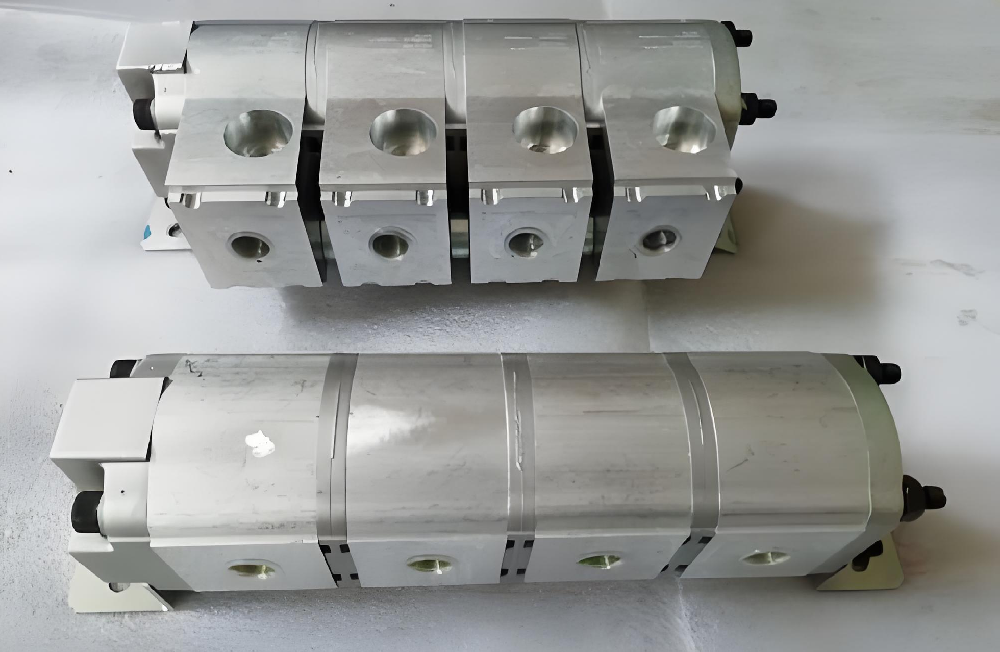
The Casappa PLD20/4/31.5 is a high-precision hydraulic component engineered for applications demanding exact,synchronized movement.This unit functions as both a gear flow divider and a hydraulic synchronization motor,designed to reliably distribute a single source of hydraulic flow into multiple,highly consistent streams.With its robust construction and gear-based mechanical principle,it ensures that two or more actuators—such as cylinders or motors—operate in unison,making it an indispensable solution for level lifting,precise positioning,and balanced force distribution in heavy-duty mobile and industrial machinery.
Operating Principle:The Mechanics of Synchronization
At its core,the PLD20/4/31.5 operates on a beautifully simple yet highly effective principle:the use of mechanically linked,positive-displacement gear motors.The unit consists of multiple gear motor sections(in this case,four)housed within a single,compact block.All the gears in these sections are interconnected on a common shaft.
When pressurized oil enters the common inlet port,it feeds into each motor section simultaneously.Because the gears in each section are physically connected and must rotate together,each section is forced to displace an identical volume of fluid per revolution.This mechanical coupling is the key to synchronization;it ensures that each output port delivers an equal flow rate,regardless of moderate differences in the pressure required by the individual actuators connected to them.Essentially,the device acts as a flow meter and a pump in one,dividing the total incoming flow with precision dictated by the manufacturing tolerances of its internal gears.This method provides inherently stable synchronization that is largely unaffected by variations in fluid viscosity or temperature,a significant advantage over orifice-based dividers.
Technical Specifications and Design Characteristics
The PLD20/4/31.5 is engineered with specific parameters that define its application window.The"31.5"in its model designation refers to its nominal displacement of 31.5 cubic centimeters per revolution(cm³/rev)for each of its four sections.This substantial displacement per section makes it suitable for synchronizing larger actuators.The unit is rated for a maximum continuous operating pressure of 250 bar,with the capability to withstand even higher peak pressures,ensuring durability under demanding loads.
A hallmark of the PLD20 series is its exceptional synchronization accuracy,typically between 1.5%and 2.5%.This high level of precision is achieved through precision-machined gears and minimal internal leakage paths.The standard design incorporates port connections sized for industrial use,with common configurations featuring inlet ports(designated as GE)and outlet ports(designated as GD)to facilitate integration into existing hydraulic line setups.
Core Product Features and Configurations
Modular and Scalable Block Design:The PLD20 series is celebrated for its modular"building block"construction.While the PLD20/4/31.5 is configured as a four-section unit,the platform allows for customization.The series supports configurations from 2 to up to 12 individual flow divisions,providing immense flexibility for machine designers to tailor the component to the exact number of actuators in their system.
Integrated Safety and Versatility:A critical design feature is the optional integrated pressure relief(overflow)valve on each outlet section.This valve protects individual actuator circuits from pressure spikes caused by unequal loading or end-of-stroke conditions.Furthermore,the series can be configured not just as an equal flow divider,but also as a proportional flow divider,where sections with different displacements are combined in one block to provide fixed,unequal flow ratios for specialized applications.
Robust Construction for Demanding Environments:The housing and internal components are manufactured from high-strength,corrosion-resistant aluminum alloys,ensuring a lightweight yet durable product capable of withstanding the harsh conditions found in mobile machinery and industrial plants.
Primary Applications and Industries
The PLD20/4/31.5 finds its purpose in any hydraulic system where the precise coordination of movement is paramount.
Material Handling&Lifting Equipment:It is indispensable in synchronizing the lift cylinders on platforms,palletizers,or heavy-duty forklifts to prevent binding and ensure level lifting.
Construction and Agricultural Machinery:Used to synchronize the movements of outriggers,stabilizers,or boom sections,enhancing stability and control.
Industrial Manufacturing:In presses,molding machines,or steel rolling mills,it ensures parallel closure of platens or synchronized action of multiple cylinders,directly contributing to product uniformity and quality.
Marine and Offshore Applications:Ideal for synchronizing hatch covers,winches,or lifting systems where reliable,maintenance-friendly operation is essential.
Performance and Efficiency Advantages
Implementing a Casappa PLD20/4/31.5 gear flow divider translates into significant system-level benefits.Most notably,it eliminates the need for complex and expensive electronic synchronization systems involving multiple sensors,flow control valves,and programmable controllers.Its purely mechanical operation guarantees synchronization without the risk of software failure or electrical interference.This leads to a reduction in overall system cost,simplified commissioning,and enhanced operational reliability.
The device also contributes to improved machine safety and product quality.By ensuring actuators move in lockstep,it prevents mechanical strain,component damage,and hazardous situations caused by unsynchronized movement.The integrated relief valves add an extra layer of protection for sensitive system components.
Selection and System Integration Guide
Choosing the correct PLD20 model requires careful analysis.Key selection criteria include the required number of synchronized circuits(sections),the flow rate per circuit(which,along with displacement,determines operating speed),and the maximum system pressure.For the PLD20/4/31.5,the high displacement per section makes it optimal for applications needing significant flow at moderate to high pressures.
Successful integration requires attention to system design.Adequate filtration is mandatory to protect the finely machined gears from contamination.Designers must also plan for the case drain connection,which allows internal leakage oil to return to the tank,preventing pressure buildup within the housing.Understanding the load profile on each actuator is crucial,as extreme and persistent load imbalances can affect the longevity and accuracy of the unit.
Frequently Asked Questions(FAQs)
1.What is the fundamental difference between a gear flow divider and a hydraulic synchronization motor?
These are two names for the same functional component."Gear flow divider"describes its primary action of splitting one flow into several."Hydraulic synchronization motor"describes its purpose and operational principle:using interconnected hydraulic gear motors to force synchronized output.The Casappa PLD20/4/31.5 performs both roles simultaneously.
2.How does the synchronization accuracy of 1.5-2.5%translate in a real-world application?
This figure represents the maximum potential flow deviation between outlets under specified conditions.For example,in a system lifting a platform with two cylinders,a 2.5%accuracy means one cylinder could theoretically extend up to 2.5%faster than the other.In most industrial applications,this level of precision is more than sufficient for smooth,safe,and controlled operation,often surpassing the performance of competitively adjusted valve-based systems.
3.Can this unit synchronize actuators under unequal loads?
Yes,this is one of its key strengths.Due to its positive displacement,mechanically linked design,each section must displace its volume of oil.It will generate the different pressures required at each outlet to move differently loaded actuators,all while maintaining nearly identical flow rates.The integrated relief valves protect each circuit if the pressure difference becomes excessive.
4.What are the consequences of not using a case drain line,or having it blocked?
Omitting or blocking the case drain line is a critical error.Internal leakage,which is normal for any hydraulic motor,will have no path to escape.This will cause pressure to build inside the housing,potentially leading to shaft seal failure,internal damage,and catastrophic unit failure.The case drain must always be piped directly to the reservoir with minimal backpressure.
5.Is this unit suitable for use with fire-resistant fluids or water-glycol mixtures?
While the standard PLD20 series is designed for mineral-based hydraulic oils,specific seals and material compatibility should be verified with the manufacturer or distributor for use with alternative fluids like water-glycol or certain biodegradable oils.Casappa's HDD series of cast iron flow dividers is often recommended for more aggressive media.
No.26, District 4, Maquanying Liyuan Community, Xiangjiang North Road, Cuigezhuang, Chaoyang District, Beijing.
+86 18221112592
https://www.hydraulic-supply-company.com